


Cecil Lee
Staff
-
Joined
-
Last visited
Everything posted by Cecil Lee
-
Dear Elaine, Since the house is rented; and working from a 2nd bedroom. If you are converting or using the 2nd bedroom rather than the main bedroom (1st bedroom) then, you can do so. For the position of the tables /chairs; it is always best to prioritise ie. make sure that the tables are positioned based on Good Shapes and Form Feng Shui (first). As an example, the table should not be directly facing the bedroom door. Where possible the table should not be on the same wall or against the same wall (with the opposite side) .... is the toilet. Please see below:- If you are using a bedroom (usually a place of rest) then, you may have to try to use the Yin and Yang concept. during `office hours' try to make the room as Yang as possible e.g. bright etc..to encourage a `business like' environment. `after-office hours' make the bedroom as yin as possible to encourage (rest) or sleep. Yes, it is important to understand good Feng Shui practises correctly. It may take time but; usually the effort pays. Avoid `fast food' Feng Shui whenever we can. Such as reading a book that `promises' that by decorating a sector... one will receive wonders... Warmest Regards, Cecil
-
Dear Nini, Please see below:- This can be very subjective. And it depends on individuals. Some of us may be highly sensitive to certain issues e.g. storage below the bed. While others may not. Some of us have heard a tale, where a princess could not sleep even if there is a small piece of needle below her pillow case. Alternatively, it may be biological or some other issues/daily concerns/problems that make one unable to sleep. Frankly, there is not much one can do; other to do a test.. i.e. try removing the storage for a week and see if one still sleeps comfortably. (If this can be done). Your second question was addressed in another recent forum message. Warmest Regards, Cecil
-
Dear Nini, I agree with Deborah on this. One important concept in Feng Shui is " If it no longer can be seen (the threat) it no longer becomes a threat. Therefore, one of the easiest thing to do, e.g. a threat looking into a window is to use curtains or blinds. Blinds are a better alternative in such a situation since, one can manipulate it to filter as much light into the room (if possible). Warmest Regards, Cecil
-
Further to this, we usually want to know where is the `head of the house'. This is quite similar to the situation of the fatal error of `chopping' off the head of the house. Ref: http://www.geomancy.net/fs/grandpa1.htm If we look again at symbolism in Feng Shui we can imagine that the two twin towers are like the two human legs. Where the head (like an ostrich) buries his head underground and its body is in the middle. We can imagine an "upside-down" person with his head buried in the ground and his body holding the two legs sticking up in the air. This "ostrich effect" of an `upside down person' kicking its two legs above, shows dire predictament. And is another Shapes and Form `interpretation' of the inauspiciousness of the twin towers. Warmest Regards, Cecil
-
Further to what I mentioned below:- Under the Shapes and Form Feng Shui, another bad omen is that the twin towers resemble a tuning fork. Because, such towers uses steel/metal girdles or frames, depending on the wind conditions, with such tall structures, they would `resonate' between each other like a tuning fork (creating Sha Qi). This is why, for building construction (Feng Shui) it would be best to construct a single tall structure (that is not attached to a twin tower). Warmest Regards, Cecil
-
We are all sadden by the acts of terrorism against America. Coincidentally, under Shapes and Form Feng Shui; the two tallest (twin towers) are considered inauspicious shapes. This is because, the two towers is symbolic of an offering of " Two jossticks " e.g. during a funeral rites. In Asia, when we visit a `wake' (funeral of a loved one of our friends/relative); we pay our respects by lighting up two joss sticks - as a respect to the deceased. We would offer the joss sticks in front of the coffin and for some, bow three times. Thus, two large buidlings e.g. sticking out like two joss sticks spells inauspiciousness and represent death. Coincidentally, this has unfortunately happened. It would be difficult in China or Asia, for buildings to have twin towers; particularly that tall. A building may have one tower taller (but the second tower should be lower). For example: the United Overseas Bank (UOB), Singapore and the Westin Hotel, Singapore both have one tall tower and a shorter second tower. This would negate the bad symbolism of an offering of two joss sticks. Thus, it was sad that eventually, when we see the two buildings on fire, they looked like two joss sticks on fire. Warmest Regards, Cecil
-
Dear Sharon, While your explanation is thorough, it is recommended for an individual to physically inspect the location. Despite the possibility of the main entrance being at the front of the road or a side entrance, it is still safe to observe the property even if the front side faces the ocean. For instance, the front side, such as the side facing the ocean, can be perceived as the front side instead of the actual front side accessible from the road. Warmest Regards, Cecil
-
Dear Cc, It depends! There is certainly no universal approach here. In fact, FS practitioners would respond by saying that it depends on the sector:- 1. Yin and Yang balance If the place is kinda dark, e.g. west facing, then a mirror (may) help here. This is based more on intuition or personal feelings. 2. Based on Feng Shui rulesets It is the common understanding that a bad sector may bounce back twice the bad luck. For example, under the Flying Star Theory, if a particular sector is inauspicious or especially if the sector is not properly cured. E.g. sickness sector or misfortune. Then, it could imply that one could inadvertently; a mirror at that specific location may bounce back TWICE the bad luck. "Caution... my friend " Warmest Regards, Cecil
-
A truly sad day indeed! God save our souls if this is true.... two bro = two towers of wtc ? fortress = pentagon? -This is really scary what Nostradamus predicted! ?In the City of God there will be a great thunder, Two brothers torn apart by Chaos, while the fortress endures, the great leader will succumb? , The third big war will begin when the big city is burning? - Nostradamus 654 THIS IS SPOOKY ......... Bush vows to punish terrorists and their hosts September 11, 2001 Posted: 10:00 PM EDT (0200 GMT) WASHINGTON (CNN) -- President Bush issued a warning Tuesday night to any nation that may be giving refuge to those responsible for the terrorists who destroyed the World Trade Center and severely damaged the Pentagon. ?We will make no distinction between the terrorists who committed these acts and those who harbor them,? the president said from the Oval Office of the White House as he promised retaliation. U.S. intelligence officials told CNN, ?There are good indications that persons linked to Osama bin Laden may be responsible for these attacks.? Afghanistan, believed to be the home of bin Laden, denied he was connected to the attacks. Asked if bin Laden was a suspect, Defense Secretary Donald Rumsfeld said, ?It?s not the time for discussions like that.? Other U.S. officials said that while the focus is on bin Laden, they have not ruled out other suspects. They also said they believe more threats exist. Pentagon sources told CNN that all U.S. military sites around the world have gone to ThreatCon Delta, which means that a terrorist attack has occurred or an attack at a specific location is likely. Secretary of State Colin Powell said there were ?no specific warnings? before the attacks. Knives and box cutters Although officials said the attacks appeared to have been well planned and executed, a passenger on the plane that hit the Pentagon said in cell phone call to her husband that the terrorists were armed with knives and box cutters. The passenger was Barbara Olson, a CNN commentator and wife of Solicitor General Theodore Olson. We will expend every effort and devote all the necessary resources to bring the people responsible for these acts?these crimes?to justice,? Attorney General John Ashcroft said Tuesday evening. The president suggested how many people may have been killed in the attacks when he said ?thousands of lives were suddenly ended.? American Airlines Flight 11, carrying 81 passengers and 11 crew members en route from Boston to Los Angeles, slammed into the north tower of the World Trade Center in Manhattan shortly before 9 a.m. About 15 minutes later, United Airlines Flight 175, also en route from Boston to Los Angeles, with 56 passengers and nine crew members aboard, crashed into the south tower. It is not yet known how many of the estimated 40,000 to 50,000 people who may have been in the World Trade Twin Towers were killed when the two planes exploded and eventually turned both 110-story structures into piles of rubble. Hours later, fire caused another building, 7 World Trade Center, to collapse. It had been burning since shortly after the planes stuck the Twin Towers. Other nearby buildings are ablaze in the area. Asked how many people he believed were killed, New York Mayor Rudy Giuliani said, ?I don?t think we want to speculate about that?more than any of us can bear.? Almost 300 emergency personnel in New York -- 78 missing police officers and 200 firefighters - are presumed dead along with the 266 people on the four hijacked airplanes. There is no word on fatalities at the Pentagon, where part of the complex collapsed after a Boeing 757 jet plowed into it at 9:45 a.m. Witnesses said the plane hit what is known as the ?Army Corridor.? FBI sources said the aircraft was an American Airlines flight that had been hijacked after taking off from Washington Dulles International Airport bound for Los Angeles. At least 53 people were injured, some severely, in the attack on the Pentagon, where about 24,000 people work. All secretaries and military chiefs of the service branches are alive and have been accounted for, authorities said. A fourth aircraft, United Airlines Flight 93 from Newark, New Jersey, headed for San Francisco, crashed in a wooded area near Shanksville, Pennsylvania. Police said there were no survivors. There were 38 passengers, five flight attendants and two pilots. ?The plane is thoroughly disintegrated,? Jim Marker of Somerset County?s 911 Emergency Management Center told CNN. ?There are no remains, no survivors. Senior FBI sources said, ?There is no doubt the planes [all four] were hijacked.? Intelligence sources told CNN there were indications of attempts to divert the United flight from Newark to crash at Camp David, Maryland, the presidential retreat. It is unclear how that plan may have been thwarted. U.S. military officials said none of the planes were shot down by U.S. aircraft. Federal Aviation officials said they were aware at the time the first plane crashed into the World Trade Center that a plane had been hijacked. They did not know that specific plane was involved. Callers from two of the other hijack planes called on cell phones to say their planes had been hijacked. Hijackers may have flown planes James Kallstrom, the retired FBI agent who led the investigation into the explosive crash of TWA 800 in July 1996 that killed 230 people, said he believed the hijackers must have flown the planes into the buildings themselves. ?I can?t imagine any American pilot crashing an airplane into one of these buildings, even with a gun to the head. They wouldn?t do that,? said Kallstrom. ?You?ve got people that not only are willing to give up their lives for a horrendously, in my view, stupid, cowardly act, but they are sophisticated enough to fly a modern jet plane.? The U.S. military went on full alert. Two aircraft carriers left the Naval base in Norfolk, Virginia, in response to the attacks to provide upgraded air defense for New York and Washington. Officials in Washington said a ?Continuation of Government? plan had been activated. The activation involves a fortified facility at Mount Weather, Virginia. There was no word whether any of the U.S. leadership or ranking military officers had been taken to the facility. The city of Washington declared a state of emergency. ?The Pentagon is functioning. It will be in business tomorrow,? Rumsfeld said. Members of Congress were quick to blame bin Laden, the Saudi millionaire blamed for bombings at two U.S. embassies in Africa. He is believed to be based in Afghanistan. ?This looks like the signature of Osama bin Laden,? said Sen. Orrin Hatch, R-Utah, who said he had been briefed by officials at the highest levels of government. Hatch added: ?We?re going to find out who did this and we?re going after the bastards.? ?This is obviously an act of war that has been committed on the United States,? said Sen. John McCain, R-Arizona. In Kabul, Afghanistan Foreign Minister Wakeel Ahmed Mutawakkel said, We in Afghanistan do not allow Osama bin Laden to use Afghan territory to launch any attack on any government around the world.? He said the Afghan government had taken away bin Laden?s communication devices,? and he has not been in touch with anyone outside Afghanistan.? Mutawakkel said the Taliban will conduct its own investigation. ?We will determine what really happened. We denounce this terrorist attack, whoever is behind it.? Hours later, explosions and flames lit up the night sky over Kabul, provoking speculation the city was under by the United States forces in retaliation. Rumsfeld denied any U.S. involvement and a senior Taliban ministry official said the attack on an ammunition dump came from two helicopters flown by a rebel group called the Northern Alliance. Security tightens in U.S. The attacks in the United States set off security alarms across the nation. Federal government buildings in Washington, including the White House, were evacuated. Airports in San Francisco and Los Angeles, the destinations of the planes involved in the incidents, were evacuated. The city of San Francisco declared a state of emergency. California government offices also closed. The U.S. House of Representatives planned to convene Wednesday in a symbolic gesture to show the government is not shutting down. For the first time in U.S. history, the Federal Aviation Administration closed airports nationwide, halting the 36,000 to 40,000 takeoffs that occur daily. It diverted a number of trans-Atlantic flights to Canada. By midafternoon all domestic flights that had been in the air when the closings were order had landed, said FAA spokesman Less Dorr. ?The earliest the national groundstop will be lifted is noon tomorrow [Wednesday]. And that?s at the very earliest,? said Dorr. The Immigration and Naturalization Service went on highest alert along the U.S. borders with Canada and Mexico. Source and Credit:- ? 2001 Cable News Network LP, LLLP. An AOL Time Warner Company. All Rights Reserved. Terms under which this service is provided to you. Read our privacy guidelines. Contact us.
-
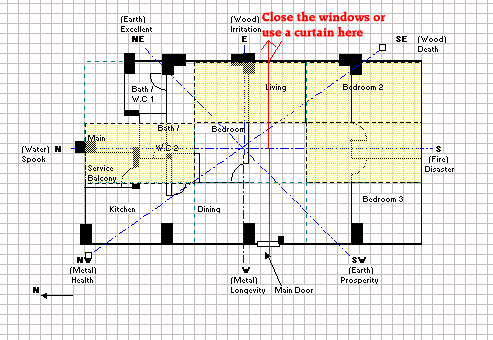
Dear Benjamin, I like to elaborate further as to the common misunderstanding on the use of the Eight House Theory:- 1. Generally, it is often used to find out how suitable the house is to the breadwinner. Since the bedroom door is located at your "Longevity" sector; it can be considered that the house (in general) is suitable to you. 2. Other important sectors according to this theory is " How long do you spend your time at that sector ". It is considered good if one spends time at a good sector. 3. If one does not spent much time at a sector, it really does not apply as much. Thus, even if your `excellent' sector is at the bathroom; if one does not spend time at that sector... it does not mean much. Here, it does not mean that since your `excellent' sector is in the bathroom that one tries to find an excuse to spent more time there. If you do not spent much of your time in room2, there is really no issue there. Some FS practitioners feel that it would be advantages if the kitchen is a good sector particularly to the spouse or homemaker. If not, it does not really matter that much. Warmest Regards, Cecil P.S. Attached please find the sketch of your layout plan where it is best to try to make sure that `Qi' does not flow direclty out from the main entrance to the living room (balcony? or windows).
-
Dear Anon, For motor homes, usually, we can only take advantage of its location viz-a-viz the area it is in. It should not be parked in locations where, it is in direct `force' of wind e.g. barren land where, wind blows directly towards it. It is really difficult to apply many of the concepts of Feng Shui to the motor home. In my opinion, more can be gotten from Pillars of Destiny or improvement to personal self here. Warmest Regards, Cecil
-
Dear Anon, Based on my personal experience, a toilet above the 2nd floor would depend on:- 1. The level of usage of the toilet. 2. The higher the ceiling, the better. Under Para 1; water or water vapour may release `negative ions' or water gases so; it is always advisable to keep that toilet as dry as possible. One good thing is that usually, the sewerage pipes are on ground level (unless you also have a toilet) directly above it. It is best to place the bed away from piping from below. Sometimes, because of the gypsum board or false ceiling of the toilet, we may need to explore this further. It is best if the water heater (some of these) are located directly above the bedroom. Stay clear if possible. Warmest Regards, Cecil
-
Dear Benjamin, 1. To side track (a-bit); I suddenly realised that the forum message under Free Advice (General Topics) is now close to the 5,000 messages mark. 2. I `suddenly' thought of this because, I could still vaguely remember one reply or several replies within the 2,000 message mark on this issue. I cannot blame anyone for not reading the previous message on this. So here goes.... 3. Lilian Too is not wrong in this aspect. This is because, in the `Traditional Eight House Theory'; the backdoor is considered of prime importance because this will determine the type of house e.g. a North house; South house etc.... 4. Here again, I like to emphaise that when one reads a `concept' from an author or site; one should read or apply the concepts; i.e. step-by-step from THAT particular site. And not `mix' and match concepts or steps from one book to another book or to another site. 5. Why is this so? For example, in this site; I have considered users using the common denominator e.g. a handy " ordinary compass ". 6. So when I first devised the Eight House Theory and how to take the compass reading using a Step-by-step guide i.e. it is based on:- 6.1 Template where North is North and South is South. Some Eight House map would use the traditional model of South on the top. 6.2 With the use of the ordinary compass, standing at the centrepoint of the house to determine the direction of the main entrance door = the direction of the door. E.g. a South House. This site uses this concept. 7. However, if one uses a Chinese Luopan; one tries to find the `sitting' (can be the back door) and facing direction i.e. the front or the main entrance. This is why the `backdoor' is considered important or why Lilian Too mentioned it. 8. The Flying Star Theory The Flying Star Theory has made some improvements in the way the `back-door' or `front door' is used. Thus, Flying Star in the traditional model contains the two key words: Sitting direction and Facing direction. Where sitting is (the back) and facing (the front) especially if the Chinese Luopan is used to find the direction. 9. Here again, this site, makes it easier and the true north is = true north. And the direction of the main door can be found if one stands at the centrepoint of the house facing the main entrance door. 10. Therefore, I must again emphaise that one cannot litterally take the work `backdoor' or `front entrance' as being universally equal in meaning by all authors; or sites. Warmest Regards, Cecil
-
Dear Anon, Feng Shui refers (in general) to the Earth Luck of a home. Feng Shui is about trying to increase the Earth Luck or trying to harmonise the home. Feng Shui thus cannot be done by `remote control'. For example, if one does not live in a particular house e.g. Smith Street, USA and say he/she resides in Trafagar Square, UK. His `earth luck' (the breadwinner's) would then be based on the house that of the home he currently resides i.e. Trafagar Square, UK. And not the house in Smith Street, USA. If the breadwinner stays in the UK. Then the person who earns the most and staying in Smith Street, USA; would instead be consider the breadwinner of this house. Warmest Regards, Cecil
-
Dear Benjamin, 1. Currently, I understand that you are applying the Eight House Theory. 2. The most popular use of the Eight House Theory is:- 2.1 To find out how suitable the house is to the breadwinner. If the main entrance direction happens to be the death/disaster sector - particulary to the breadwinner than, this house is considered the `most' unsuitable for the breadwinner. 2.2 Do note that under the Eight House Theory one clue is that one must spent time at a sector in order to get the influence. Thus, it does not matter (as much) if say your death sector is in the toilet. Especially if one does not spent so much time there. 2.3 It is good to find out what is the intangible force affecting each member of the family in the bedroom. Other than the above; the Eight House does not mean more. Or one cannot extract more from the Eight House than the above. 3. Do note that the Eight House Theory cannot be further reduced to the Lowest Common Denominator i.e. The Five Elements Concept. This is thus it's inherent weakness. 4. One must take note that in Traditional Feng Shui practise; The Five Elements is the basis of it. For example, under Ba Zi or also known as Eight Characters or Pillars of Destiny; it takes into consideration - The Five Elements Concept. So does The Flying Star Theory which also uses the Five Elements Concept. 5. Thus, both Ba Zi and The Flying Star Theory have as a powerful tool the common denominator = The Five Elements concept to compare and be used for `horizontal' and `vertical' analysis. 6. I usually do an full audit combining the two i.e. Ba Zi and The Flying Star Theory. The summary found under http://www.geomancy-online.com - The report called " Group Analysis " is the means which the two are `combined' and provide a very detailed analysis taking into consideration the above two plus the Eight House Theory. The salient points or important `exceptions' are highlighted in the above report providing what we call a `Helicopter' view of both the Earth Map and Heaven Map combination. Warmest Regards, Cecil
-
Dear Jyoti, You can understand more on how to use an ordinary compass at this url:- http://www.geomancy.net/fs/cecilcompass.htm Useful information on step-by-step guide in finding the 4 good and 4 bad directions:- http://www.geomancy.net/fs/house1.htm To generate your free Eight House Report and other reports:- http://www.geomancy-online.com Warmest Regards, Cecil
-
The Strathclyde MBA:- http://www.sgbs.strath.ac.uk/StrathclydeMBAhome.shtml International Centres:- http://www.sgbs.strath.ac.uk/International.shtml URL: http://www.worldclassmba.com
-
Dear Jonathan, Currently, we are looking at it from the point of view of Shapes and Form Feng Shui. As `corner' or `sector' Feng Shui e.g. South-West = Romance/relationship sector can be quite misleading. This type of `sector' Feng Shui; in my opinion is too general to be considered applicable to everyone. However, if we use Shapes and Form, (as a `replacement' to this `sector' Feng Shui; we are concerned with the placement of the bed in-relation to the bedroom. It is always best to place the bed on the opposite wall of the bedroom door provided there is not a window there. If there is a window, there; then there should be a gap between the bed and the window. In Shapes and Form Feng Shui; one consideration is that two bedroom doors should preferably not face each other. (Best avoided as; it was felt that the parties living in either of the bedroom may `clash' or quarrel. For example, the son and say another sibling. Other FS theories and concepts can be applied further. But, this depends on the level of participation or non-participation into the use of them. Warmest Regards, Cecil
-
Dear Beng Swan, 1. For Feng Shui in business, the most vital question asked is: 2. Is my business doing as well as those IN the SAME industry? 3. For example, if one owns say a provision shop in a neighbourhood. One shop is doing well and the other is not doing as well; Feng Shui can help. 4. But if one's company is e.g. in the Dot Com industry; where there is a high rate of `cash burn'; no amount of Feng Shui can help in such a situation. 5. For businessess, it also involves many factors e.g. 5.1 Marketing / Competitiveness of the good i.e. pricing 5.2 Is your market a niche market? or entry into the market is easy/difficult? 6. Is your marketing channel adequate? Advertising? Acceptance of your product and service? Are you marketing your project in new channels such as the internet - this can be quite an uphill task especially if people want to touch and feel the product and buy it immediately from a shop rather than the internet. The above are some of the diverse issues or considerations that you have to make. They are not the least, the final questions that need to be asked. Other factors may be involved. Warmest Regards, Cecil
-
Dear Melody, 1. The most common `neutral' colour is white. Or pastel shades of white. Locally, many condominiums like to paint the interior e.g. beige or tones of it. 2. White is an acceptable colour because it is considered or represents - the metal element. Metal element is one of the best colours to use because; it can be used to cure both " bad earth elements e.g. #2 sickness and #5 misfortune and others such as bad wood e.g. #3. 3. When Ba Zi is applied, we look at the element and strength of the person living in the particular room. For example, if the person's element is weak wood; a FS practitioner may advise the breadwinner to paint the room to suit this person e.g. either neutral white (if there are some imbalances where green (wood) or blue (water) element cannot be used. 4. The `Binding' Element In a further example, assuming that this is the master bedroom where: 4.1 The husband's element is Strong Wood while 4.2 The wife's element is Strong Earth. We can introduce a `binding' element to benefit both of them i.e. to benefit Strong Wood and Strong Earth. The element that can benefit both elements is = Metal. Thus, in their bedroom, one can e.g. consider painting the room white and since one of them is the breadwinner, areas where both spent time at e.g. the living room and the dinning room can use more of `metal' element to help bind their relationship. Reference: The above report is available under www.geomancy-online.com (Group Analysis Report). For those who do not want to use a binding element could perhaps, as usual, apply `trial and error' or use their instincts or simply choose white colour for the entire home. Warmest Regards, Cecil
-
Dear SY, Thank you for your layout plan. Yes, the layout is pretty `unique' and sometimes it may not be feasible to simply divide it into shapes such as eg. Two `L' shapes as they may not be such. In your case, the preferred option is to make a photocopy of the layout plan or print it. Paste/glue the photocopy on a cardboard. Next `cut-out' the outline of the layout plan. You use a nail to balance the layout. When you are able to balance the entire `cut-out' layout, i.e. centre of gravity then use this point as the centre-point of the home. You can then from here determine the direction to the main entrance. Warmest Regards, Cecil
-
Dear Students who have completed your course in the last few months, We will be posting your Certificates this by weekend. Warmest Regards, Cecil Lee
-
Dear Benjamin, Please see below:- Yes, it is prefered to have a water fountain at the frontage of the house. Usually, the water fountain should be low and this would represent clear space at the front. And a fountain can help to circulate `vibrant' Qi at the entrance. In your case, you can still leave the fountain there but consider other water element e.g. in colour such as grey, black or blue. Warmest Regards, Cecil
-
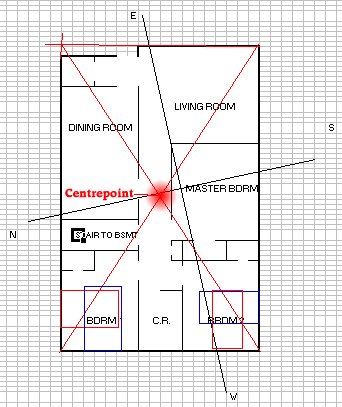
Dear Anon, Thank you for your layout plan. 1. Based on Shapes and Form FS (without consideration to other Schools), in my opinion, I would prefer bedroom 1, which is above the laundry area as opposed to bedroom 2, above the kitchen. 2. Attached please find the layout plan: house.jpg which shows the preferred position of the bed in bedroom 1 and 2. Marked by a rectanglar in RED and in BLUE. Depending on the window position, the head of bed if possible is preferred not to rest against a window. 3. I have marked the centrepoint of the home. Even if you are just renting a bedroom, you can take a compass reading of the house and check the `Eight House' of your room to see whether Bedroom 1 is better or Bedroom 2. If Bedroom 2 is auspicious under the Eight House, then, you should try to use this room instead of Bedroom 1. Warmest Regards, Cecil
-
Dear SL, When the Flying Star course starts, in early October, you can find out more about how to draw the Flying Star Chart. It uses a formula and is not directly related to the I-Ching. Warmest Regards, Cecil