


Cecil Lee
Staff
-
Joined
-
Last visited
Everything posted by Cecil Lee
-
Dear Betty, Under the Eight Aspirations or Life Associations where each trigram is associated with an aspect of life. Here are the significance of each trigram and their direction: North - Career South - Fame East - Health West - Children North East - Education North West - Helfpul patrons South East - Wealth South West - Romance / Marriage Therefore, to answer your question, Health is neither at West or North but at the East. The above is based on the Later (last) Heaven Sequence. 1. We cannot `compare' this theory with the Shapes and Form School where the Shapes and Form can be applied to every location. The Eight Aspirations is considered too general to be applied to everyone with accuracy. 2. Even the Eight House Theory takes into consideration our Year of birth. The Eight Aspirations has no relation to or `personalised' to an individual. So far all the serious practioners and users of Feng Shui have low regard for this `association'. As mentioned sometime back in a few messages, only after one has used all the `serious' Feng Shui techniques and if one has the luxury or to put it `crudely' too much time in our hands, can then out " boredom " do what wants to `enhance' these areas. If one follows the above `argument', it is the same if a specific life association falls in the kitchen etc... If one follows these `concepts' one may end up not following Traditional Feng Shui. For one, there is little or no relation to the Five Elements Concept or Yin and Yang (at the higher level). The test of authentic Feng Shui concepts is that it must be based on the Five Elements or at least on Yin and Yang Concept. For example, even under the Shapes and Form School, it is related to Yin and Yang. For example, an excellent site is where the Yang Dragon (male) is at a gentle embrace with the Yin (female) tiger. Anything but BTB is encouraged in this forum. Warmest Regards, Cecil
-
Dear Andy, I see that you’re new to the forum, and I’d like to extend a warm welcome to you! Based on some of the most basic Feng Shui ideas, you can arrange your desk using three main Feng Shui concepts: A. Shapes and Form School: 1. Try to place one side of your desk against a pillar or wall to give you a sense of support. 2. It’s best if there isn’t a walkway directly behind your desk. Ideally, you should have a solid wall behind you for stronger support. 3. Avoid sitting directly under a column or beam. 4. Try to avoid “poison arrows,” such as sharp corners or edges pointing directly at you. 5. Your desk should not be easily visible from the doorway or directly facing the door. 6. It’s also better if your desk is not next to a toilet or directly facing one. These are some of the general things to keep in mind. B. East/West Group Persons or Eight House Theory: Once you’ve taken care of the Shapes and Form School guidelines, then you can consider facing one of your favorable directions while seated. Do remember that the Shapes and Form School is more important than point B. Don’t rearrange your desk to face a good direction if it means creating an “island” position or putting yourself in a poor sitting spot, such as having your back facing the room’s door. C. Yin and Yang Concept: You can place a small plant on your desk to make the space a bit more Yang, since a growing plant represents life and activity. Because this is an office environment, it’s generally better to make it more Yang—brighter and more energetic. Check that your desk lighting is bright enough for your work. If it isn’t, you might want to use an anglepoise or table lamp. Try not to have water features, such as an aquarium, in the room, as they create a more Yin environment and may affect your mind slightly, including your ability to concentrate. What I’ve shared above doesn’t include more detailed Feng Shui analysis, such as using the Flying Star Theory, and so on. Warmest regards, Cecil
-
Dear Buck Seng, Thanks for posting your message. Frankly, the hardest to reply are messages related to Shapes and Form especially if one is not physically present to comment. This is many things can be missed out e.g. especially whether the TPE follows towards the house in a curved manner inwards or outwards. In addition, the height of the flat and many more relating to the dragon and tiger elements etc... Therefore, I sincerely hope you understand that it is not fair for me to make a comment unless one is physically there. Shapes and Form assessment is unlike other questions posted here where it is about concepts etc... Other than Shapes and Form School, you should also consider e.g. the Eight House Theory at http://www.geomancy.net/fs/house1.htm to see how suitable each of the house is in relation to you. Pay particular attention to the death / disaster intangible force and how each member can `stay' in a particular house. Please accept my sincere apologies for not being able to answer your question. Warmest Regards, Cecil
-
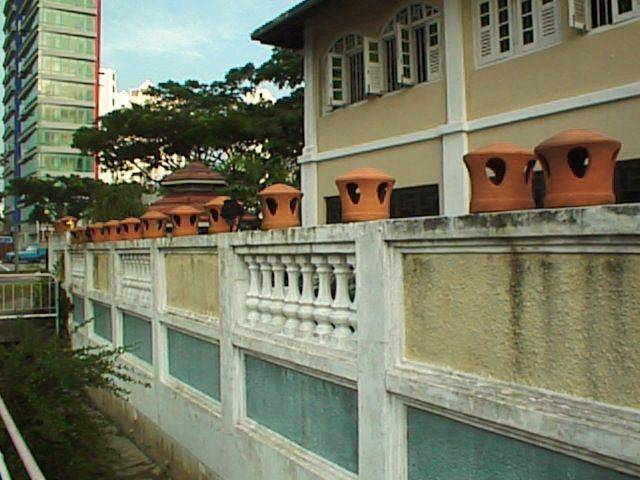
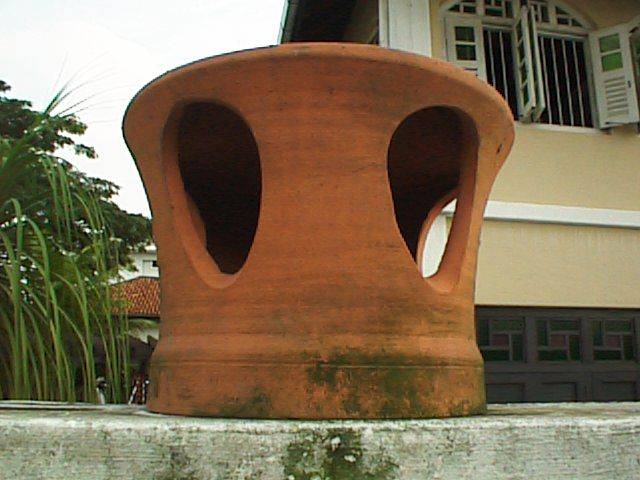
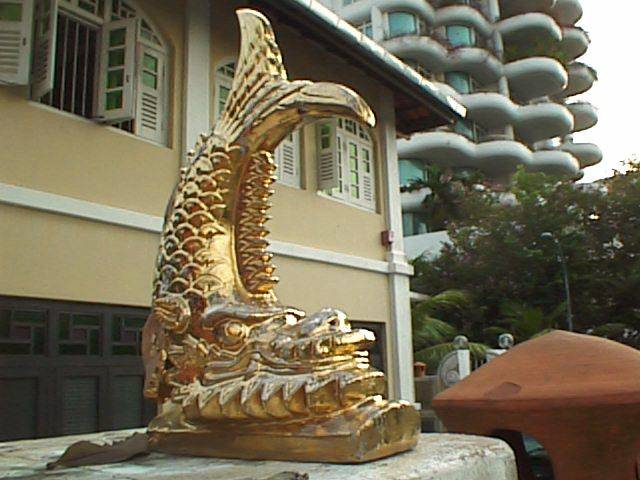
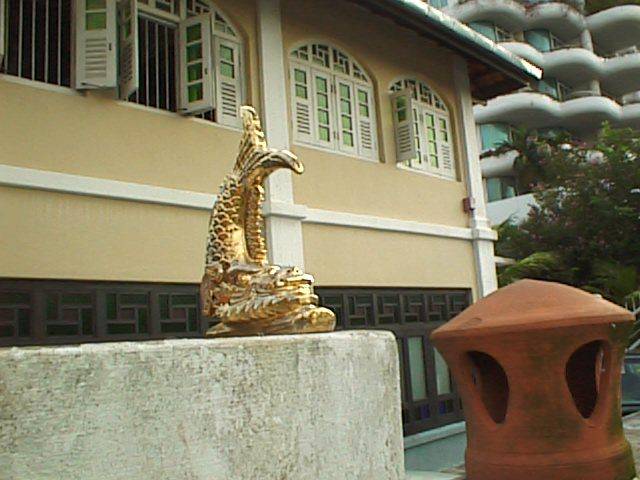
Dear Anon, Glad that you have `sharp' eye sight. Frankly, I did not comment on the half fish structure because I wanted to know if anyone would ask about it. Well, the more important point is the use of the clay (earth) light holders as I mentioned earlier that represents light. In Feng Shui, light is also considered one of the `items' that can aid in enhancing Qi. Here light is equivalent of water positions like a fountain. This half fish object can be seen under two context: 1. It is equivalent of the object used to light the clay (earth) light holder. Here, you understand that symbolic is again very important in Feng Shui. The shiny metallic half fish creature thus symbolise the `activation' of light for the clay light holders. 2. `Scary' creatures are sometimes used by some Feng Shui practioners against poision arrows or `to protect' the residents. This depends on the FS practioner. Some feel that all this is "rubbish". In my opinion, Para 1. is a more `objective' way of looking at the object. Para 2 is for those who have `religious' inclinations. You can also consider it as not necessarily religious but like the Kei Loon object you see in an earlier picture, many objects are used to `guard' the house/gravesite etc... Many buildings in my country have two huge lions beside the main entrance door as `guardians'. Warmest Regards, Cecil
-
Dear Anon, Thanks for your feedback. Glad that you and your friends enjoyed the pictures. I will continue to whenever I find something interesting to post it here especially your comments about home interiors and the garden. I hope everyone can understand that as I am alone, it would not be possible to post daily. What I normally do is to bring along the digital camera and if something interesting `pops up' will try my best to take pictures of them. As Singapore has quite alot of traffic police... can only take photos when at stationary positions. If anyone has something interesting to share e.g. photos for comments, can always post it under the " Conference for Attaching Layout ". I can always comment on them. Even if there are no pictures at times, do continue to participate actively in the conference or `listen' in on the messages. Warmest Regards, Cecil
-
Dear Donna, Frankly, I can only comment based on Feng Shui directions as I have little information without info on the analysis using Flying Star. Under the harmony of the Five elements (rudimentary Feng Shui concept). Under the Five elements concept: 1. NE = Earth element or Yellow. The ugly cream you mentioned can be considered the Yellow element. Implication: a. Cream is in general considered a `harmonious' colour as it is the colour of the Earth element. b. Under the Flying Star analysis, so long as there is no strong Earth or No. 2 numeral at the NE, this colour is acceptable. If there is a star 2 at this location, best not to use cream colour. 2. If you are painting the door Red, do take note that the colour Red; under the productive cycle supports Earth element. Under para 1, again there should not be a star 2 at the above location as Red will only increase the strength of the Earth element. 3. Under the Five Elements destructive cycle, Wood or colour Green destroys Earth. If there is a star 2 at this location, it is good to use colour Green. The above is usually how the colour scheme is analysed based on the Flying Star theory. However, if you do not want to use the Flying Star method, you may have to trust your sixth sense and choose a colour of your liking. Warmest Regards, Cecil
-
Dear Anon, Thanks for this interesting question: 1. I remembered reading quite sometime back one of Evelyn Lip's book on Geomancy (Feng Shui). (By the way, for those who are not aware, Evelyn Lip is an English author of several Feng Shui and Chinese cultural books. She is a trained architect and has a PHD. Her books are considered academically correct and is useful for those who do research for their school projects.) In the above book, she mentioned that when she was a young architect, she had a `culture shock' when she was asked to design a house. After the architectural plan was submitted to the house owner; she was asked to alter the design for the owner. During this period, she was `introduced' to Feng Shui as the owner had consulted a Feng Shui Master. In turn, the owner had asked her to alter the plans based on recommendations by this FS Master. 2. From the above `story' you will realise that it is usually `driven' by the owners of the house/complex/office. Some owners of buildings consult a FS Master after the plans of the house has been drawn up. 3. In a magazine sometime back last year, this article mentioned that an architectural firm clinched a deal (the client is Asian) for a commercial complex building because the architectural firm has a competitive advantage i.e. one of the architects had knowledge of Feng Shui. 4. Not all buildings in Singapore and Hong Kong are based on Feng Shui. It depends on the owners/developers. Because of the diversity of races, some may believe and hire FS consultants while others do not. 5. You mentioned that the building behind the house at the junction is marvellous because it is rounded. Yes, it is the same building where I took the most recent rounded circular steps with plants on both sides of it. (Under the conference " Photo Tours of Interest), which is not sent by mailing list but only can be seen by those that login to the website forum at www.geomancy-forum.com This building has also a swimming pool at the frontage of the house. As it is rounded, it is considered a house with water element. 6. For the Suntec City, where the entire project is symbolic of a person's left hand, this project is a mega project and some of the owners are tycoons from Hong Kong. Naturally, they had hired a FS Master from Hong Kong to develop the concept. 7. Later on under the Photo Tour, I will show a building in Singapore called the Gateway which is also based on Feng Shui concept but is unfriendly to its neighours as it gives off sha qi to its surroundings. 8. Unlike the West, if I can recall, most if not all projects are done by Traditional Feng Shui consultants using the Compass School and Shapes and Form School. Fortunately, we do not have projects done by `others' e.g. those that use static Feng Shui templates quite common in some western countries with so much of such influence. These "schools" have no place in countries with Chinese influence especially Taiwan, Hong Kong, the Far East and even China. Hope the above helps you to better understand the relationship between the owner/developer, the architects and the FS Master. Warmest Regards, Cecil
-
Dear Lily, The calculation of the Hourly branch i.e. the first part is taken from zi (rat) but the Heavenly stem requires one to look at the Day pillar together with zi (rat) to find out the Heavenly stem of the hour. Therefore if one looks at it zi (rat) whether it is zi-early rat or zi-late rat does not matter. What is more important is to get the Day correct. Essentially, if one understand how Pillar works, the hour pillar is not that necessary as not all analysis refer to the hour pillar. However, with the hour of birth one can get more accuracy i.e. more elements to analyse especially for house of life. House of conception does not need the Hour pillars. Robert who is an expert in Pillars of Destiny knows almost every School under this field and has adopted the best practises and discarded `long-winded' and sometimes `non logic' steps in such a process. As he had mentioned earlier for example, the Hour stem is based on 12 hours and 11.pm to 12.59pm is = zi (rat). He does not believe in complicating the process by dividing zi into `earlier & later' zi because one can know whether it is before or after 12.00. This is only for referencing but in terms of practical calculations, `earlier and later' zi is always = zi. The reason why some Hong Kong Practioners want to use the above method is because for Chinese, most of them refer to the Chinese dates as the Heavenly stem and Earthly combination such as e.g. jia-zi Year and Hourly branch for e.g. yi-zi. To make it easier for them to tell at a glance, they may call it yi-early zi or yi-later zi. By doing so, the can glance yi-later zi as 11pm onwards. If it is yi-early zi, it refers to early morning 12 to 1am. This is all it is used. As we are using Solar dates as the main source of conversion, this is no longer necessary. Hsia has a major flaw in that is unable to tell a `blind' year. While Solar method uses the best of both as it is cross referenced to the seasons under Hsia. There are lots more `illogical' practises which are found in some other calculations. It is always good to adopt the best practises and discard practises that may not be necessary. Warmest Regards, Cecil
-
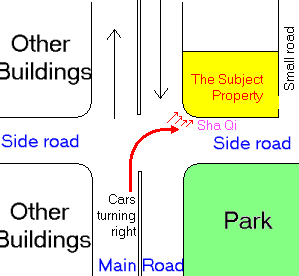
I have accidentally uploaded a .psp file which can only be opened by certain graphics program. Here is the same layout plan under .gif format. This picture is with reference to: " House at Junction of a main road - with Sha Qi ". Thanks. Cecil
-
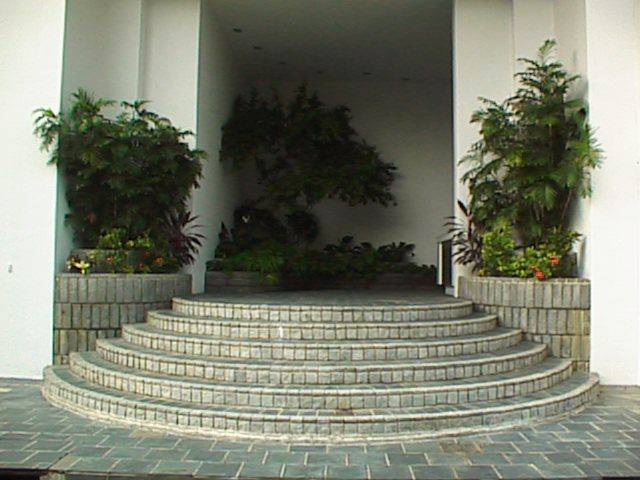
In addition to the semi-circular steps, the building entrance has plants on both sides of the semi-circular steps. This is acceptable practise (based on Taiwanese Feng Shui concept).

-
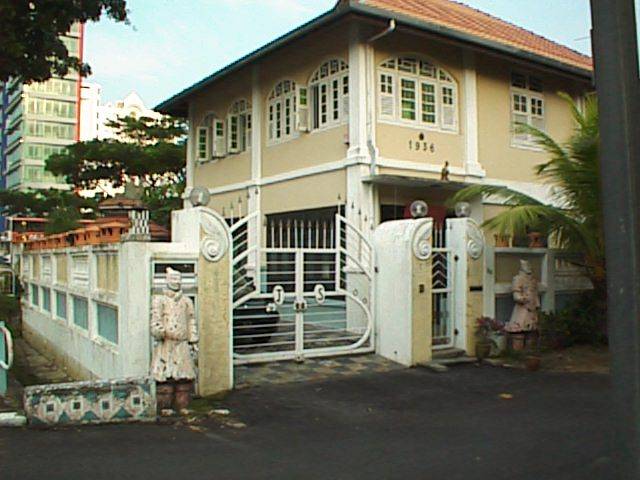
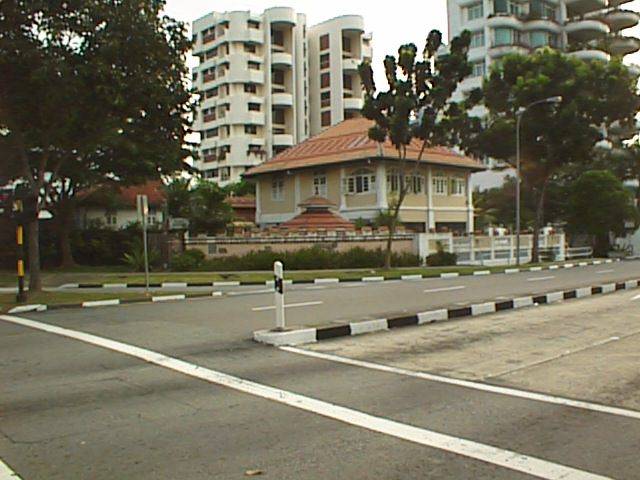
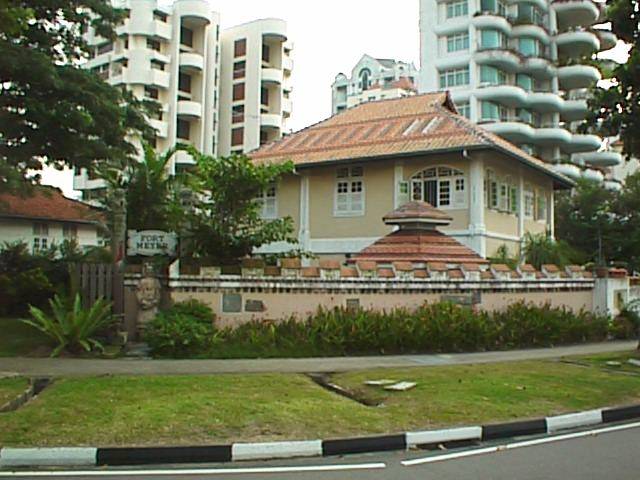
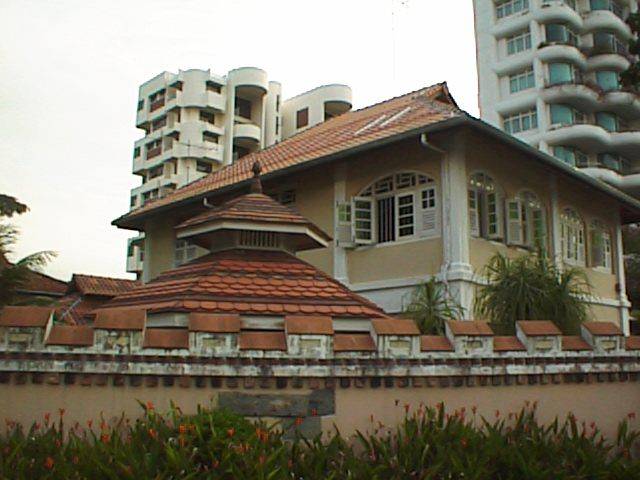
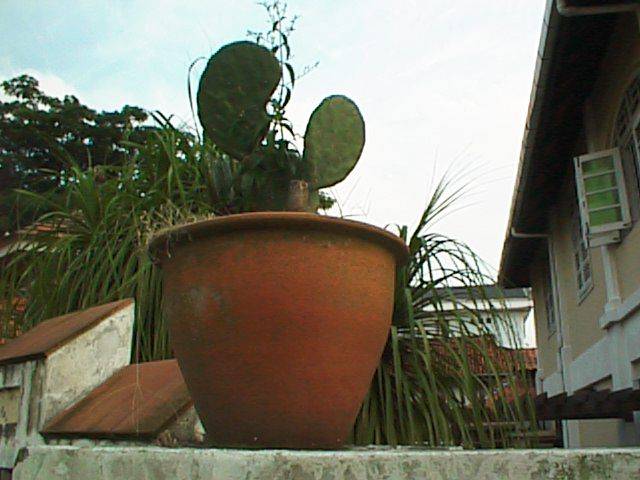
This house is at a junction of a busy main road. 1. See what this houseowner has `done' to protect the house against Sha Qi (or poision arrows) from moving vehicles. 2. There are several close up views of how the house owner placed a row of " Earth lamp holders " on the side wall of the house. This is symbollically meant to keep the `compound' " bright ". To ehance qi. Besides this the owner also placed a potted catus plant on the wall where the traffic flow (sha qi) is pointed towards the house. ---- Readme: ----- Note: Apologies, I had uploaded the second picture: location-plan.psp under .psp (Paint Shop Pro format). Please do not download this unless you have pain shop pro). (There is no harm downloading but you may not see any picture as it will be shown as an invalid format). The alternative file is under a new topic: "Replacement Layout plan for the topic: House at the Junction...."
-
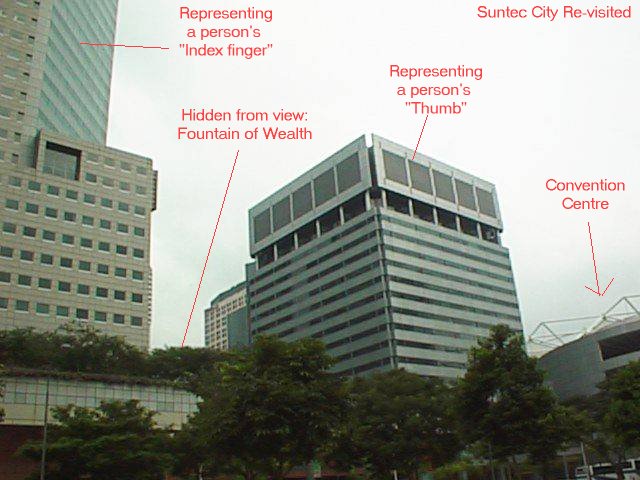
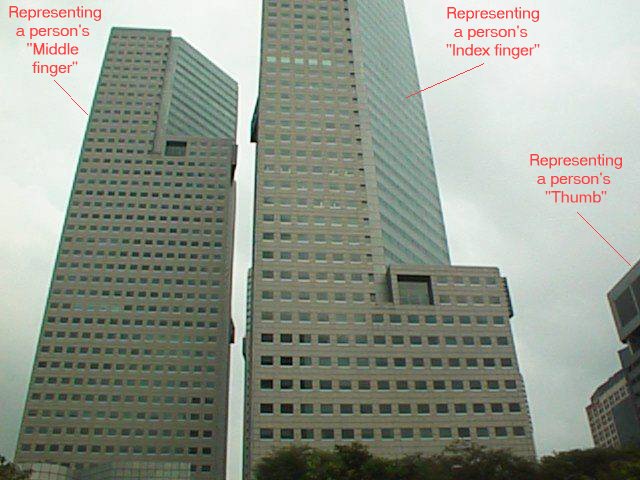
Here are two pictures showing the view of the "Thumb", "Index finger" and the "middle finger" of the Suntec City as mentioned in an earlier topic " Currently with the world's largest `Fountain of Wealth'. For more information, please read previous message "Suntec City / Fountain of Wealth Re-visited".
-
Dear Anon, There is really nothing you can do except to consider placing a potted plant (if this is possible) on the left side of the door. Warmest Regards, Cecil
-
Dear Christine, Appreciate if you can give us a better idea the reason why you are worried about your kitchen in the North East. More importantly, priority should be given to the Kitchen based on the Shapes and Form School of Feng Shui. For example, the stove should have a solid back and not against a window. Since the stove is on the north wall, it can still be located at the north wall. However, the only caution here is that since it is at the north wall, you should not place a water position facing the stove. The sink can be at the west wall. Again it should not too close to any fire element and keep a distance for it. Other than the above, I believe there is no issue in having a kitchen at the NE. Warmest Regards, Cecil
-
Dear Anon, This is based on very general theory. I would rather classify this as textbook cures where Book authors will ask explain the location eg. South = Fire and let you do whatever necessary to enhance the location based on a fixed element. I believe all your four questions, what has been done is to simply super-impose the Four Symbolic animals `exactly' into the home environment. This is really not the correct way to apply Feng Shui based on the Five elements. For example, the South is already considered warm. Introducing a warm object e.g. a Phoenix would add more `Fire' into the location. If there is already `petty' quarrels within the sector, introducing or adding more Fire is not going to help. Under the Five Element concept, a good element to add would instead be of the Earth element e.g. pottery. As cools down Fire. Warmest Regards, Cecil
-
Dear Anon, There is some truth in what was mentioned: 1. Under the Imperial Carpentry, most chairs should preferabley have armrests. 2. The profile of the lamp shade is important consideration in Feng Shui: /\ / \ || A lamp shade should preferably be `pointed' upwards. This stands for progress. Circle lamps are also considered good Qi generators i.e. light is considered generally good in Feng Shui. If one wants to use five light bulbs, it can be circular in shape and can either be made of crystal, glass or plastic. The material is not as important. Avoid lamp shades or lighting hanging in an upside down position: || \ / \/ This firstly looks like a poison arrow. Secondly, it means `down' or failure. Warmest Regards, Cecil
-
Dear Lin Huang, Please see below:- Yes, a child's bedroom can be placed above the kitchen. This is based on priority. For example, under the Eight House theory, if the bedroom is auspicious sector for your child, you can let him have the bedroom. Feng Shui is based on commonsense and it is belief that many fires in a home start in the kitchen. As fire rises, it may affect the bedroom above. But here, if it is an auspicious sector for the child, you can let him/her have the room. In the kitchen, one should always keep it clean and tidy. One can even invest in smoke detectors etc... The answer is similiar to the above. Yes you can especially if it is an auspicious sector of the house for the person `occupying` it. Priority here is as you have mentioned to have a staircase landing that `turns'. More importantly it should not have `gaps' but full steps that are covered fully. 14 and 8 steps is acceptable. Congratulations on your new home. Warmest Regards, Cecil
-
Dear Anon, As you have asked three questions that seems like superimposing the Four Symbolic Animal literally inside a home, generally, this is considered a `flawed' and is akin to practising Feng Shui the BTB way or commonly recommened by some book authors without due regard to proper Traditional Feng Shui. Warmest Regards, Cecil
-
Dear Anon, One cannot simply apply the Dragon and Tiger in the way you have mentioned. What I mean is that if you are relating to the objects: be it a picture, painting, statue of a dragon or tiger, one cannot say that say the picture of the dragon has to be at the left side while the tiger is on the right side. Firstly, one should not display such objects especially in a bedroom. One can still display the objects under the following conditions: 1. Ideally, the dragon can be displayed but for a purpose: a. It has to be a four claw or less dragon. b. It can be displayed facing a door. c. It can be displayed looking out of a window facing a poison arrow. Especially if the poison arrow is a metal lamp post, flag pole etc... This is due to the `breath' of the dragon being of the fire element. Fire destroys metal. The reason why some use it to face a main entrance door is because the Dragon (being the most Yang animal) has Yang energy and helps to `neutralise' the Yin especially if it is an inauspicious sector. Being Yang, it symbolises brightness and is similar as keeping the place "bright". Equvalent of brightening the area e.g. white paint or light up the area. 2. If a tiger is displayed in the home, it should not be ferocious, seems hungry or looks like stalking a pray. This is considered inauspicious. Warmest Regards, Cecil
-
Dear Anon, For your question on " Is it necessary to hang it "; I have mentioned in detail under the last message " Does pakua needs to be prayed upon in order for it to be effect. In the above reply, I have mentioned that there are two main uses of the Ba Gua mirror: 1. To deflect poison arrow. 2. To ward off evil spirits. I have dealth in detail the above. Please see below:- 1. The most important point to remember is to hang it according to the First Heaven Sequence formation. Info about the First Heaven Sequence is found at http://www.geomancy.net/fs/pakua.htm 2. One more point is that it should not be hang inside the house. It should be hang facing out of the house. For example, the most common way is to hang above the main entrance door. 3. It can be centrally above the door. It can also be hang below a window especially if it is a flat/apartment to deflect a poison arrow e.g. the sharp edge of another tall building aimed at the house. Other than the above, you can hang it away from the home. Usually, it is hang in the middle of the window. One can place a Ba gua mirror at separate locations. So far, I have yet to see anyone hanging two Ba gua mirrors togther side by side. Warmest Regards, Cecil
-
Dear Anon, To understand if the tree is a `threat' to your home, do check out the following questions: 1. If one stand at the main entrance and if the tree slices the house, this is considered a poision arrow. 2. If it slices through the window, it is a poision arrow. As I understand from your message that the tree on the right side of the house, this is usually acceptable. 3. If you have a relatively large garden or if the tree is quite a distance away from the house, this is acceptable. In Feng Shui, a tall, large tree is considered too Yin especially if it is at the compass direction of NE, NW and West. But as you mentioned that it is the SE location, this is still acceptable. Keep the tree (if possible trimmed). 4. The branches usually are not considered sha qi as it is natural for the tree to branch out in all directions. Rather, the tree trunk is usually considered a `threat' if meets conditions under Para 1 and 2. 5. Overall, the tree should be healthy. If it is this is acceptable. But if the tree decays or rots, then it is adviseable for it to be pulled down. 6. A tree stump or broken tree stump is considered inauspicious especially if it `acts' as a blade cutting or slicing a home. Warmest Regards, Cecil
-
Dear Chris, Thanks for your very interesting question. As a guide, usually our surroundings is `governed' by Feng Shui analysis using the Shapes and Form School. Here, Shapes and Form is used at the Environment Scanning ie. the Landscape, the Site and the Home. We can loosely term the above as Macro Feng Shui. It is important in the above to locate the dragon (yang) embracing the tiger (yin) or we consider this a gentle embrace. In addition, in the macro level, there should preferably be a solid backing (tortise) and clear space - infront (phoenix). In Macro Feng Shui, we also analyse the enviroment in relation to the Five Elements concept. Here, if there are lots of `wood structure' buildings e.g. surrouding buildings need not be made of wood but tall and thin, one can built a house / building of Metal to destroy the surrounding wood structures thus the end result is to create wealth for the building. Again we should apply the 33.3 percent concept. In the macro environment, we (as a person) cannot influence much our environment. Our environment: between buildings and landscape can influence each other. Next, at the micro level, we can then concentrate on the influence on ourselves. Many a times, if a person lack wood e.g. a weak wood person, a FS practioner may advise adding more "wood" in the home etc.. For those who have learned Economics, i.e. Macro level and Micro level, if we apply the same to Feng Shui at Macro and Micro level, then we can begin to understand the relationship of man and his immediate surrounding has the greatest influence. Buildings and each other and the surrounding have another relationship. Hope the above helps. Warmest Regards, Cecil Lee
-
Dear Louis, One technique is to hang a mirror. It need not be full length but should cover the head, face and the upper part of the body. However, before doing so, it would best to look at the sector based on Flying Star theory to make sure that the location is not inauspicious. If the location is auspicious, placing the mirror is acceptable. But if it is an inauspicious location, placing a mirror will bounce back twice the bad luck. The mirror is used (in consideration) of the above so that it extends the pillar outwards. Without further information, I am unable to comment further. Warmest Regards, Cecil
-
Dear Daren, Yes, a clock is considered a form of Sha Qi especially if it faces your house through a window. You can apply the rule: If one cannot see the Sha Qi, it no longer becomes a threat. See if you can come up with something e.g. draw the curtain etc... Another consideration is the clock. The smaller the better. Warmest Regards, Cecil
-
Dear Anon, This is not exactly true. In traditional Feng Shui, it is common for a FS practioner to advise the home owner to instead tilt the door facing one of his good direction. Here, it is adviseable to consult a FS consultant on the exact tilt degree. In the above situation, it is said that one kills two bird with one stone. For example if the door happens to be an inauspicious direction, by tilting the door to an auspicious direction, it solves the problem of the inauspicious door and also enable the owner to have the door face his good direction. Other than the above, it is also quite common for a FS practioner to advise his client to tilt the door especially if it is at the North East and South West to avoid the Devil's gate and backdoor. Warmest Regards, Cecil